Showing posts with label 2016. Show all posts

Sunday, March 5, 2017

Victoria's cold winter of 2016-17

We've recently come to the end of meteorological winter (December 1 to February 28), and it was definitely an unusual winter in Victoria.  The biggest stand out was the temperature - this past winter was the coldest in 38 years in Victoria.  The last time we had a winter this cold was back in 1978-79.  Victoria has actually experienced 20 winters in the last 120 years that were at least this cold.  However, all of those winters were prior to 1980, so we're just not used to it  any more!

The mean temperature this past winter was 3.9 degrees, roughly 2 degrees below the 30-year average of 5.8 degrees.  The average daily maximum/minimum this winter was 6.1/1.6, again roughly 2 degrees below the normal winter daily max/min of 7.9/3.6. 

The chart below compares the daily maximum and minimum temperatures this winter with the 30-year average temperatures.  You can see that the temperatures were pretty consistently below average, with just a couple of brief spells of milder weather. 
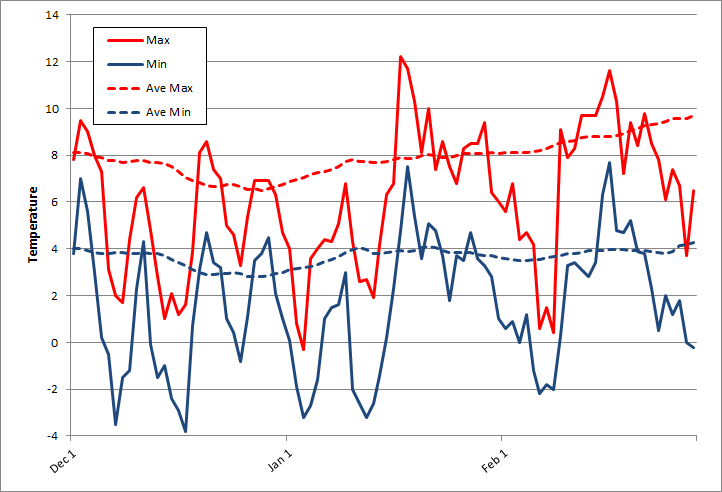
Daily maximum & minimum temperatures in Victoria, winter 2016-17


Victoria experienced 25 days when the temperature dropped below freezing this winter, compared with the average of 8.8 days.  Again, that’s the most days since the winter of 1978/79.  However, the record was 41 days in 1912/13.  While we had a lot of overnight lows below freezing, it never really got that cold in Victoria this winter.  The coldest temperature was -3.8 degrees on December 17.

Conversely, Victoria experienced daytime temperatures above 10 degrees on just 7 days this winter, compared with the average of 20 days.  Last winter (2015/16) there were 28 days above 10 degrees and the winter before that (2014/15) there were 42 such days - six times as many as this winter.  To put it another way, just 8% of winter days this year were above 10 degrees, compared with 47% of winter days in 2014/15.   

The colder weather was partly the result of a number of arctic outbreaks, bringing cold sunny weather to Victoria.  As a result, total precipitation for the winter was below normal: 222 mm versus the 30-year average of 264 mm.  The chart below compares the daily and cumulative precipitation at Victoria Gonzales this past winter with the 30-year normal precipitation.  While December was a bit wetter than normal, January was very dry and February was about average.  The highest daily rainfall was 26 mm on February 9.  Overall, there were 46 days with measurable precipitation this winter, which was right on the average.

Daily & cumulative precipitation in Victoria, winter 2016-17


As usual, Victoria was much drier than surrounding areas, as shown in the chart below.  Compared with Victoria Gonzales (222 mm), the Victoria Airport (315 mm) had 50% more precipitation, while Seattle (430 mm) and Vancouver (469 mm) both had about twice as much. 


Winter 2016/17 brought the first significant snowfall in 5 years to Victoria.  Not surprisingly, snowfall was above normal.  Total snowfall for the winter was 29 cm, almost double the 30-year average of 16 cm for December to February (total annual snowfall averages 20 cm in Victoria).  There was 8 cm of snow in December, just 1 cm of snow in January, and a whopping 20 cm in February (versus normal of 9 cm for December, 3.4 cm for January, and 3.6 cm for February). In terms of days with snow on the ground, Victoria got off not too badly (especially compared with Vancouver and up-Island): there were 5 days with at least 1 cm of snow on the ground this winter compared with the normal of 4.5 days during December to February.

Sunday, October 16, 2016

A fairly normal September

September was slightly wetter and slightly cooler than normal in Victoria, but nothing too extreme.

Rainfall for the month was 27.6 mm, a bit more than the 1981-2010 average of 23.9 mm for September at Victoria Gonzales.  There were 9 days with measurable rainfall (compared with the normal of 6.5 days), with the highest amount (11.6 mm) on the 17th.  The Victoria Airport received just slightly more rainfall in September, 31.1 mm.

The mean temperature was a bit lower than the 1981-2010 average: 14.2 degrees versus 14.6 degrees.   September 2016 ended a nine month streak of above average monthly temperatures at Victoria Gonzales: it was the first month since November 2015 to be below normal temperature.  While September was a bit cooler than the average for the past 30 years, if you look at the past 119 Septembers at Victoria Gonzales, this month's temperature falls almost exactly middle of the pack (i.e. the median).  The average daily max and min temperature this September was 17.6/10.6.  The average max temperature was about one degree below normal, but the average min temperature was right on the normal.  The highest temperature for the month was 22.9 on the 13th while the lowest was 6.6 on the 30th.  At the Victoria Airport, the mean temperature was 14.3, which was slightly higher than the 30-year average of 14.1.

Saturday, September 3, 2016

A look back at summer 2016

Now that August is over, meteorological summer (June, July, and August) is also over.  Summer 2016 started out a little more unsettled than usual in Victoria, but in the end it turned out to be very nice.

At Victoria Gonzales, there was a total of 41 mm of rain during June, July, and August.  That's a little drier than the 50 mm that Victoria receives on average during the summer, but nothing unusual.  In fact, about 40% of the summers at Victoria Gonzales over the past 118 years have been drier, with the driest summer (1970) receiving just 10.5 mm of rain during June, July, and August.  While this June was a little wetter than normal, July and August were both a little drier.  There were 15 days with measurable precipitation during the summer, which is right on average.

The chart below shows daily rainfall during summer 2016, and compares the cumulative rainfall with the 30-year average.  You can see that June and the first week in July was generally a little wetter than average, but then it was very dry until the last few days in August.  From July 10 to August 27, there was a seven week stretch with just one day and only 1 mm of rain, and from July 23 to August 27, there was a 36-day period with no measurable precipitation.  That's a little longer than the typical drought period that Victoria receives each summer, which averages 28 days.

Daily and cumulative rainfall, 2016 vs 30-year average

The chart below compares Victoria's rainfall during summer 2016 with a number of other locations.  Compared with Victoria Gonzales' 42 mm, the Victoria Airport actually received slightly less rain, at 38 mm.  In Vancouver, there was 105 mm at the Airport and 156 mm downtown at the Harbour (so nearly four times as much rain as Victoria).  Up-Island also had more rain than Victoria, with 115 mm at Nanaimo and 95 mm at Comox.  Rainfall in Seattle was closest to Victoria, although there was still nearly twice as much, with 68 mm.  Finally, I have included Toronto's 133 mm.  There was a lot of coverage in the news about the drought affecting Southern Ontario, so this shows that everything's relative: even with one of the worst droughts in memory, Toronto still received more than three times as much rain as Victoria this summer.

Total rainfall, summer 2016
Now lets talk about temperatures.  The mean temperature for June, July, and August at Victoria Gonzales was 16.4 degrees, substantially higher than the 30-year average of 15.6.  In fact, summer 2016 was the 6th warmest in 119 years of record-keeping at Gonzales.  (Last year's summer, at 16.9 degrees, was the warmest on record.)  June's mean temperature of 15.5 degrees was 1.0 degrees above normal, while July's mean of 16.1 degrees was right on normal.  It was August when things really heated up: the mean temperature of 17.5 was 1.2 degrees above normal and just 0.1 degrees below the all time record.  In fact, at the Victoria Airport it was the hottest August on record.

The chart below shows the daily maximum and minimum temperatures at Victoria Gonzales during summer 2016, compared with the 30-year averages.  You can see that there were spikes of above average temperatures in June and again in August, while temperatures in July stayed very close to the average.  The warmest temperature of the summer was 33.1 degrees on August 19.

Daily maximum and minimum temperatures at Victoria Gonzales , summer 2016


Friday, September 2, 2016

A dry and very warm August

August in Victoria was drier and much warmer than normal.

After experiencing very average temperatures in July, Victoria was much warmer in August.  The mean temperature for the month was 17.5 degrees, making it the second warmest August on record at Victoria Gonzales, just a sliver behind the record of 17.6 degrees in 1997.  The Victoria Airport set a new record for the warmest August in 2016, with a mean temperature of 18.3 degrees, beating the old record of 18.1 set in 2004.  Since the beginning of 2014, 29 of the past 32 months have been warmer than the long term average in Victoria.

The chart below compares the daily high and low temperatures with the averages for August.  Temperatures fluctuated between being close to average and being well above average.  The warmest temperature during the month was 33.1 degrees on August 19th.  That was not only a record for the date, but it was the warmest temperature ever recorded at Gonzales for any day after August 15.  Heat waves like that are rarer in the second half of August than they are earlier in the summer.
Daily maximum and minimum temperatures, August 2016


For most of the month, August was very dry, with no measurable rainfall until the 28th.  Victoria then received 7.2 mm during the last four days of the month.  That was still well below the normal of 18.6 mm for the month, but not usually so: in the past 119 years, Victoria Gonzales has had less than 7.2 mm during August 28 times, or about one quarter of the time.

The chart below compares daily and cumulative rainfall in August 2016 with the average cumulative rainfall for August.  You can clearly see how most of the month was very dry and well below the average.

Daily and cumulative rainfall, August 2016

While, on average, Victoria Gonzales is the driest location in the region, this August there was actually less rain at the Airport: 3.2 mm vs. 7.2 mm.  It was generally dry at other nearby locations, though not quite so dry as Victoria.  In Vancouver, there was 13.8 mm at the Airport and 12.5 mm downtown at the Harbour.  Up-Island, there was 20.8 mm at Nanaimo and 26.1 mm at Comox.  In Seattle, there was just 4.3 mm of rain during August.


Tuesday, August 2, 2016

A fairly typical July

This past July turned out to be pretty typical in Victoria.

The mean temperature for the month was 16.1 degrees, which is right on the 30-year average.  If you go to 2 decimal points, the mean temperature was 16.10 versus the average of 16.07, so we did continue our streak of above average temperatures, albeit by a very small margin!  Since the beginning of 2014, 28 of the past 31 months have been warmer than the long term average.

I was a little surprised when I saw the stats for July, because it seemed to me like it was a little cooler than normal.  That may be because, while the mean temperature was bang on normal, the average daily high temperature was a little below normal (20.1 versus 20.4) while the average daily low temperature was slightly above normal (12.1 versus 11.7).  In addition, we didn't get any really hot weather during July, at least at Victoria Gonzales.  The warmest temperature this month at Gonzales was 23.1 degrees on July 21.  On average, the warmest temperature during July is usually around 28 degrees.  Victoria Airport also saw close to average temperatures in July, although the highest temperature for the month was a warmer 27.0 degrees, also on July 21.

The chart below compares the daily high and low temperatures with the averages for July.  You can see that the temperatures stayed very close to average throughout the month, with no big swings above or below the averages.

Daily Max and Min temperatures, July 2016


July was drier than average, with 8.0 mm of rain at Victoria Gonzales compared with the normal of 12.6 mm.  However, that's not an unusually low amount for Victoria -  there's been less than 8 mm of rain during more than 4 in 10 July's over the past 100 years.  There were five days with measurable precipitation in July, which is pretty typical for Victoria.  The wettest day was July 7th, with 2.8 mm of rain.

As is typical, Victoria Gonzales received less rain in July than other locations in the region.  Compared with 8 mm at Gonzales, the Victoria Airport received 13.6 mm.  In Vancouver, there was 32.8 mm at the Airport and 59.2 mm downtown at the Harbour.  The Seattle Airport received 18.3 mm.  In Nanaimo, there was 34.0 mm of rain


The chart below compares daily and cumulative rainfall in July 2016 with the average cumulative rainfall for July.  While we ended up the month with a little less rain than average, it was actually quite typical.

Daily and Cumulative Rainfall, July 2016


Saturday, July 9, 2016

The Year So Far

We've completed six months of 2016, so I thought it would be worthwhile to take a look at the weather in Victoria so far this year.

In terms of temperature, this has been a record warm start to the year.  Last year (2015) was the warmest year on record at Victoria Gonzales, and the first six months of 2015 were also the warmest ever recorded (10.8 degrees).  In 2016, we have beat that record, with a mean temperature of 10.9 degrees for the first six months of the year.  Every month so far in 2016 has been above normal temperatures.  Will we beat 2015 the the whole year record?  Probably not.  July 2016 is so far looking to be much cooler than last July, and with La Nina looming, the end of the year may also be cooler.

The chart below compares daily high and low temperatures with the 30-year averages.  You can clearly see that temperatures have been pretty consistently above average, although we've had a few short stretches of average or slightly below average temperatures in late May and into June.

Daily High and Low Temperatures, January to June 2016

Things are a bit closer to normal when we look at precipitation.  In the first six months of 2016 we have had 261 mm of rain, compared with the normal of 296 mm.  Incredibly, nearly one quarter of the year's rain so far this year fell on a single day - February 15 - when we had a record-breaking deluge of 62 mm.  Without that one day, we would be under 200 mm for the year so far.

The chart below shows daily and cumulative rainfall at Victoria Gonzales for the first six months of 2016.  You can see that we have generally trended below average for most of the year.  You can also see that incredible deluge that we had on February 15.

Daily and Cumulative Rainfall, January to June 2016

Mixed weather in June

After a string of months with warmer and drier than normal weather in Victoria, things were a bit more mixed in June.

The mean temperature for the month was 15.5 degrees, 1.0 degrees above the 30-year average of 14.5 degrees.  The average daily high/low at Victoria Gonzales was 19.7/11.2, again above the average of 18.5/10.4.

The chart below compares the daily high and low temperatures with the averages for June.  The warmest weather of the month was during the first week of June, with temperatures topping out at 30.2 degrees on June 5.  Only about one in five Junes at Victoria Gonzales sees the maximum temperature exceed 30 degrees, so that is relatively uncommon, especially for early June.  The rest of the month was pretty close to average.

Daily High & Low Temperatures at Victoria Gonzales, June 2016
After a dry April and May, precipitation in June was a bit above average, with 26.3 mm compared with the normal 20 mm.  There were 8 days with measurable precipitation in June, slightly above the average of 7 days.  The greatest amount was 9.4 mm that fell on June 15.

While the Victoria Airport typically gets more rain than Gonzales, this June it actually received slightly less - about 24 mm vs. 26 mm at Gonzales.  In Vancouver, there was 58.2 mm at the Airport and 84.1 mm downtown at the Harbour.

The chart below compares daily and cumulative rainfall in June 2016 with the average cumulative rainfall for June.

Daily & Cumulative Rainfall at Victoria Gonzales, June 2016