Showing posts with label winter. Show all posts

Friday, March 1, 2024

After wild fluctuations, winter 2023-24 was slightly milder then normal

 Meteorological winter is from December 1 to February 29.  Winter 2023-24 was colder and drier than normal.  

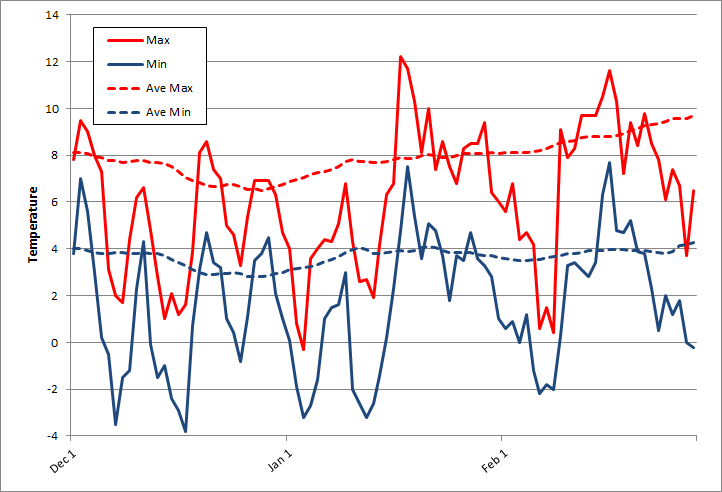
The mean temperature at Victoria Gonzales this past winter was 6.5 degrees C, compared with the 30-year average of 5.8 C.  The average daily maximum temperature was 8.5 C (versus normal 7.9 C), while the average daily minimum was 4.5 C (versus the normal 3.7 C).  December was much warmer than average.  January was slightly colder than average, while February was slightly milder than average.


The chart below shows the daily maximum and minimum temperatures at Victoria Gonzales during winter 2023-24, compared with the 30-year averages.  The cold snap in mid-January really stands out, with temperatures far below normal. The temperature dropped as low as -11.5 C on January 12, the coldest temperature recorded in Victoria in 55 years (since December 1968). 

Despite the cold snap, there was also some warm weather.  December 2023 was tied with December 1939 as the warmest on record in Victoria, with a mean temperature of 7.7 C, more than 2 degrees above the 30-year average.  There was also an extraordinary mild period at the end of January, when a Pineapple Express atmospheric river brought warm subtropical air into the region.  The 5-day period from January 28 to February 1 was the mildest 5-day period ever recorded during the winter in Victoria.  The mean temperature was 11.8 C, and highs exceeded 15 C on January 29 & 30.  There were also 3 days with overnight lows above 10 C - by far the earliest that has ever occurred in Victoria.  The previous earliest occurrence was March 12. 


Winter 2023-24 saw very close to normal precipitation.

The chart below shows daily precipitation during winter 2023-24, and compares the cumulative precipitation with the 30-year average.  Precipitation tracked close to average throughout the winter.  December and February were both slightly drier than normal, while January was slightly wetter than normal.  The wettest day of the winter was December 4th, when 19.4 mm fell.  

While precipitation was average, the number of days with measurable precipitation was above average: 51 days during winter 2023-24 vs. the 30-year average of 46.3 days.


Winter 2023-24 saw less snow than normal.  There was 8.5 cm of snow compared with the normal 14 cm.  All of the snow was recorded in January.  There were 3 days with at least 2 cm of snow on the ground - close to the 30-year average of 3.2 days for the winter.

Tuesday, March 21, 2023

Winter 2022-23 was colder and drier than normal

Meteorological winter is from December 1 to February 28.  Winter 2022-23 was colder and drier than normal.  

The mean temperature at Victoria Gonzales this past winter was 4.9 degrees C, compared with the 30-year average of 5.8 C.  The average daily maximum temperature was 7.0 C (versus normal 7.9 C), while the average daily minimum was 2.8 C (versus the normal 3.7 C).  December was much colder than average.  January was slightly milder than average, while February was colder than average.


The chart below shows the daily maximum and minimum temperatures at Victoria Gonzales during winter 2022-23, compared with the 30-year averages.  The cold snap in late December really stands out, with temperatures far below normal. The temperature dropped as low as -9.5 C on December 22, the second December in a row with a very strong cold snap and very low temperatures. January temperatures were a bit above normal, but February temperatures once more fell below normal.

Daily Max & Min temps vs 30-yr normal, Winter 2022-23


Winter 2022-23 was drier than normal, with 197 mm of precipitation versus the normal of 266 mm. Precipitation was a bit above normal in December (114 mm vs. 98 mm), but January was very dry (26.3 mm vs. normal 104.3 mm), and February was also slightly drier than normal (57.1 mm vs. normal 63.5 mm).

The chart below shows daily precipitation during winter 2022-23, and compares the cumulative precipitation with the 30-year average.  Precipitation tracked close to average during the first part of the winter, but fell below average in January.  


Winter 2022-23 was also much snowier than normal.  There was 41 cm of snow compared with the normal 14 cm.  Nearly all of the snow (37 cm) fell in December.  

Sunday, March 5, 2017

Victoria's cold winter of 2016-17

We've recently come to the end of meteorological winter (December 1 to February 28), and it was definitely an unusual winter in Victoria.  The biggest stand out was the temperature - this past winter was the coldest in 38 years in Victoria.  The last time we had a winter this cold was back in 1978-79.  Victoria has actually experienced 20 winters in the last 120 years that were at least this cold.  However, all of those winters were prior to 1980, so we're just not used to it  any more!

The mean temperature this past winter was 3.9 degrees, roughly 2 degrees below the 30-year average of 5.8 degrees.  The average daily maximum/minimum this winter was 6.1/1.6, again roughly 2 degrees below the normal winter daily max/min of 7.9/3.6. 

The chart below compares the daily maximum and minimum temperatures this winter with the 30-year average temperatures.  You can see that the temperatures were pretty consistently below average, with just a couple of brief spells of milder weather. 

Daily maximum & minimum temperatures in Victoria, winter 2016-17


Victoria experienced 25 days when the temperature dropped below freezing this winter, compared with the average of 8.8 days.  Again, that’s the most days since the winter of 1978/79.  However, the record was 41 days in 1912/13.  While we had a lot of overnight lows below freezing, it never really got that cold in Victoria this winter.  The coldest temperature was -3.8 degrees on December 17.

Conversely, Victoria experienced daytime temperatures above 10 degrees on just 7 days this winter, compared with the average of 20 days.  Last winter (2015/16) there were 28 days above 10 degrees and the winter before that (2014/15) there were 42 such days - six times as many as this winter.  To put it another way, just 8% of winter days this year were above 10 degrees, compared with 47% of winter days in 2014/15.   

The colder weather was partly the result of a number of arctic outbreaks, bringing cold sunny weather to Victoria.  As a result, total precipitation for the winter was below normal: 222 mm versus the 30-year average of 264 mm.  The chart below compares the daily and cumulative precipitation at Victoria Gonzales this past winter with the 30-year normal precipitation.  While December was a bit wetter than normal, January was very dry and February was about average.  The highest daily rainfall was 26 mm on February 9.  Overall, there were 46 days with measurable precipitation this winter, which was right on the average.

Daily & cumulative precipitation in Victoria, winter 2016-17


As usual, Victoria was much drier than surrounding areas, as shown in the chart below.  Compared with Victoria Gonzales (222 mm), the Victoria Airport (315 mm) had 50% more precipitation, while Seattle (430 mm) and Vancouver (469 mm) both had about twice as much. 


Winter 2016/17 brought the first significant snowfall in 5 years to Victoria.  Not surprisingly, snowfall was above normal.  Total snowfall for the winter was 29 cm, almost double the 30-year average of 16 cm for December to February (total annual snowfall averages 20 cm in Victoria).  There was 8 cm of snow in December, just 1 cm of snow in January, and a whopping 20 cm in February (versus normal of 9 cm for December, 3.4 cm for January, and 3.6 cm for February). In terms of days with snow on the ground, Victoria got off not too badly (especially compared with Vancouver and up-Island): there were 5 days with at least 1 cm of snow on the ground this winter compared with the normal of 4.5 days during December to February.

Thursday, March 3, 2016

A Look at Winter 2015/16

The end of February is also the end of meteorological winter (December to February).  So what was winter like in Victoria?

First, it was mild.  The mean temperature over the three month period was 6.8 degrees - a full degree above the 30-year average of 5.8 degrees.  Winter 2015/16 tied for the 7th warmest winter on record in Victoria (with 118 years of record-keeping), although it was still well below the all time record of 7.6 degrees which we hit last winter.  The average daily max/min temperature this past winter was 8.9/4.8.  The warmest temperature was 14.0 on February 9th and the coldest was -0.9 on December 31st.  There were 5 days when the temperature dropped below 0, which all occurred between December 30th and January 2nd.  The 30-year average for Victoria Gonzales is 7.6 days with overnight temperatures dropping below freezing during the winter.

The chart below shows the daily maximum and minimum temperatures this winter, compared with the 30-year averages.  You can see that, except for the last 10 days of December and the first 10 days of January, temperatures were pretty consistently above average.  This is an El Nino year, so the mild temperatures are to be expected.  In fact, the mean temperature this winter of 6.8 degrees was the same as the average for the past 6 moderate or strong El Nino winters, as discussed here.

Daily max & min temperatures, winter 2015/16
This winter was also a little wetter than normal, but not by much.  Total precipitation from December to February was 280 mm, compared with the 30-year average of 259 mm.  The chart below shows the daily and cumulative precipitation this winter compared with the average.  You can see that precipitation ran a little ahead of normal in December.  This was followed by a dry January, with just 47 mm of rain.  Most of February was quite dry as well, but the heavy one day rainfall we received on the 15th pushed us above normal for the season.


Victoria's 280 mm of precipitation this winter compared with 681 mm in Vancouver and 626 mm in Seattle (where it has been the wettest winter rainy season on record).

There was no snow this winter, and it continues a snow drought for Victoria.  We had a couple of light dustings of snow during the winter of 2013/14, but you have to go back to the winter of 2011/12 for the last time we had significant snowfall (more than 3 cm).  That's four winters in a row now with little or no snow.