Thursday, January 2, 2020

Review of Victoria's Weather in 2019

Victoria was drier and close to normal temperatures in 2019.

The mean temperature at Victoria Gonzales for 2019 was 10.7 degrees C, just very slightly above the 30-year average of 10.6 degrees.

In terms of average temperature, February was the most unusual month of 2019, being more than 4 degrees below normal.  It was the second coldest February on record at Victoria Gonzales, and the coldest since 1936.  October was also a cold month, being 1.2 degrees below the average, and the coldest October since 1984.  On the other other hand, January, May, and December were all more than a full degree warmer than normal in 2019.

The warmest temperature of 2019 came quite early, on June 12.  It was the only day in 2019 to hit 30 degrees or higher.  There were just 6 days in 2019 with daily maximums above 25 degrees, compared with the average of 9 days.  The coldest temperature in 2019 was -5.6 degrees on February 4.  That was the coldest temperature recorded at Victoria Gonzales in more than 5 years.  There were 18 days in 2019 when the temperature went below 0, nearly double the long-term average of 9.5 days.  February accounted for 13 of the 18 days with frost in 2019.

The chart below shows the daily maximum and minimum temperatures at Victoria Gonzales in 2019, compared with the long-term normal temperatures.  You can clearly see the cold snap which covered most of February, but was especially pronounced during the first part of the month.  You can also see the occasional warm spikes, such as 21 degrees in March, 25 degrees in early May, and 30 degrees in mid-June.  There were also some notable cold spikes in October and late November.


Daily Max & Min Temperatures at Victoria Gonzales, 2019

2019 was drier than average in Victoria.  There was 567 mm of precipitation, 87% of the normal 654 mm.  November and March were particularly dry in 2019, with both months receiving less than half of their normal rainfall.  July through September was wetter than normal in 2019, although with this being a dry time of year, it wasn't really that wet.

Thanks to its location in the Olympic Mountain rain shadow, Victoria receives less precipitation than surrounding locations, and 2019 was no exception.   The chart below compares annual precipitation in 2019 in locations around Victoria.  The Victoria Airport recorded 706 mm, 25% more than than Victoria Gonzales.  Vancouver Harbour recorded 1140 mm in 2019, while Seattle Airport received 861 mm.  While Vancouver received about twice as much precipitation as Victoria in 2019, that's actually less than the long term average, which sees Vancouver getting about 2.4 times as much precipitation as Victoria.

Annual Precipitation in Victoria and the Surrounding Region, 2019
The chart below shows daily and cumulative precipitation at Victoria Gonzales in 2019.  You can see that the cumulative precipitation in 2019 (red line) stayed below the average (blue line) for most of the year.  .

Daily & Cumulative Precipitation at Victoria Gonzales, 2019

There were just 111 days with measurable precipitation in 2019, well below the normal of 131 days.  In fact, that was the lowest number since 1987, when there were 105 precipitation days.  The wettest day in 2018 was January 3, with 36 mm.  Despite being a drier than average year, there were 4 days with more than 25 mm of rain in 2019, one more than the long term average 3 days per year.  There were 15 days with at least 10 mm of rain, close to the  normal of 16 days.

Victoria had more snow than normal in 2019, all of it from a snowy period in February.  Victoria received 26 cm of snow in 2019 compared with the long term average of 20 cm.  As mentioned, all of this snow fell in February, when Victoria typically receives less than 4 cm of snow on average.  There were 7 days with measurable snowfall in 2019, again all in February.  This was the most days with snowfall since 2008, and nearly double the normal of 8 days per year.  There was snow on the ground for 7 days in 2019, compared with the long term average of 4.8 days.  2019 saw the most days with snow on the ground in Victoria since 2008.

Wednesday, December 18, 2019

What are the chances of a White Christmas in Victoria?

It's just one week until Christmas, so the long range forecast is accurate enough to know that the chances for a White Christmas this year in Victoria are virtually nil.  The photo below was taken on the last White Christmas in Victoria, not long ago in 2017.  It won't look like that this year.


So what is the historical likelihood of having a White Christmas in Victoria?  Environment Canada defines a White Christmas as having 2 cm or more of snow on the ground on Christmas morning.  Using that definition, there have been just 6 White Christmases in Victoria since 1914 when the Victoria Gonzales weather station opened: 1937, 1971, 1990, 1996, 2008, and 2017.  So 6 out of the last 106 years have seen snow on the ground on Christmas morning, meaning that over that period there has been a 5.7% chance of having a White Christmas.

Interestingly, the frequency of White Christmases in Victoria has actually increased in recent years.  Prior to 1990, there were just 2 White Christmases in the 76 years from 1914 to 1989 - that's just a 2.6% chance.  But in the last 30 years (1990-2019), there have been 4 White Christmases, resulting in a 13.3% chance.  Amazingly, White Christmases have been have been more than 5 times as frequent in Victoria over the past 30 years than they were in the previous 76 years!  What's even more surprising, is that this has happened as the overall amount of snowfall in Victoria has decreased: from 1914 to 1989 average annual snowfall at Victoria Gonzales was 29.9 cm, while from 1990-2019 the average annual snowfall in Victoria was just 16.4 cm.  So why has the frequency of White Christmases increased?  It's really just up to random chance - the very infrequent snowfalls that we get in Victoria have just happened to occur at or just before December 25, giving us White Christmases.  2017 was a good example of that fortuitous timing of Christmas snow: it snowed overnight on Christmas Eve, providing a White Christmas, but it was melting by evening and all gone by Boxing Day.

Victoria averages 4.7 days per year with 2 cm or more of snow on the ground.  On any given day between November 1 and March 31, there is a 3.1% chance of having snow on the ground.  This likelihood peaks during the last 10 days of December and the first 10 days of January, as shown in the chart below.  During that 20-day period, which includes Christmas, the chance of having snow on the ground ranges between 6% and 9%.

Average Frequency of Snow on the Ground in Victoria (1955-2019)


How does Victoria compare with other locations Canada?  The chart below compares the of having a White Christmas for several cities across Canada.  To make the comparison, I have used the 1955-2019 period, for which data is readily available for a number of locations.  In Victoria, there were 5 White Christmases during this 65-year period, resulting in a 7.7% chance.  Vancouver had 6 White Christmases during this period, or a 9.2% frequency.  As shown in the chart, other Canadian cities have significantly higher chances of a White Christmas: in Toronto it's 47%, while Calgary and Halifax have a 56-58% chance.  White Christmases are almost assured in most other major Canadian cities, ranging from 75% in Montreal to 98% in Winnipeg.

Chance of a White Christmas for Selected Canadian Cities
Given that Vancouver averages 8.6 days per year with at least 2 cm of snow on the ground versus 4.7 days for Victoria, it's surprising that the chance of a White Christmas isn't much greater in Vancouver.  Again, this seems to come down to random chance.  While Vancouver only had one more White Christmas during the 1955-2019 period compared with Victoria, those White Christmases have been much snowier in Vancouver.  For Victoria's 5 White Christmases, the average snow depth was 7 cm, while for Vancouver's 6 White Christmases, the average snow depth was 20 cm.

So if White Christmases are pretty rare in Victoria, what does the weather typically look like on Christmas Day?  Based on the 30-year "normals", the average high temperature is 6.8 C while the average low is 3.1 C.  The daytime high on Christmas Day in Victoria is between 5 C and 10 C 67% of the time; it's between 0 C and 5 C 23% of the time and between 10 C and 15 C 10% of the time.

On average, Victoria gets 2.6 mm of rain on Christmas Day, although there has only been measurable rain on 51% of Christmases.  The wettest Christmas Day was 1972, with 51 mm of rainfall.  Meanwhile, Victoria averages 2.4 hours of sunshine on Christmas Day, or about 30% of the 8 hours that is possible on December 25.  There has been at least some measurable sunshine on Christmas 63% of the time, so Victoria is more likely to get at least some sunshine on Christmas Day than to get some measurable rain.


Tuesday, December 3, 2019

Fall 2019 in Victoria: Cooler and Drier than Normal

We're now at the end of meteorological autumn, which runs from September 1 to November 30.  Overall, fall 2019 was slightly cooler and drier than normal.  September was close to normal temperatures while October was the coolest in 35 years.  November was slightly warmer than normal.  Normally in the fall, rainfall amounts  in Victoria increase sharply as the season progresses - November averages more than 5 times as much rain as September.  However, this fall, rainfall was much more evenly distributed throughout the season than is normally the case.

Victoria received 190 mm of rain this fall, 84% of the 30-year average of 226 mm.  Victoria received more than double its normal rainfall in September, close to normal rainfall in October, then only 52% of normal rainfall in November.   The 68 mm of rain recorded this November was tied for the 7th driest in the past 30 years, so while it was  drier than normal, it was nowhere near record-setting (just 15 mm in November 1979).


There were 36 days with measurable rainfall during fall 2019, close to the normal 37 days.  The biggest anomaly was  in November when there were just 10 days with measurable rainfall compared with the normal 18 days.  There was a 14-day dry streak from October 26 to November 8 - the longest such streak on record during the month of November at Victoria Gonzales.  Once you get into November, dry streaks are pretty rare in Victoria.  By contrast, the longest October dry streak was much longer at 33 days, ending October 28, 1987.

The chart below shows daily precipitation during fall 2019, and compares the cumulative precipitation with the 30-year average.   Cumulative precipitation was above average for most of the fall, thanks to the wet start in September and early October.  This was followed by the 14-day dry stretch noted above during late October and early November.  Some rain did return in mid-November, but not enough to bring seasonal rainfall to normal levels.  The wettest day of the fall was November 17, with 30 mm, accounting for nearly half of rainfall during the entire month of November.


Daily & Cumulative Rainfall in Victoria, Fall 2019

Victoria is usually much drier than surrounding locations in the region, but that was less case this fall.  The Victoria Airport in North Saanich normally receives about 20% more rain during the fall than Victoria proper, but this year the Airport received only 4% more (197 mm at the Airport vs. 190 mm at Victoria Gonzales).  Seattle normally receives about 30% more fall rainfall than Victoria, but this year it only got about 16% more rain.  On the other hand, Vancouver received 419 mm, or more than twice as much rain as Victoria, which is fairly typical.

Comparison of Rainfall in the Victoria Region, Fall 2019

The mean temperature this past fall at Victoria Gonzales was 10.7 degrees, cooler than the 30-year average of 11.0 degrees.  This was the first cooler than average fall since 2013 - the last five falls have averaged 11.7 degrees.  For the fall as a whole, the average daily maximum was 13.5 degrees (0.5 degrees cooler than the long-term average) while the average daily minimum was 7.9 degrees (just 0.1 degrees cooler than the long-term average).        

The chart below shows the daily maximum and minimum temperatures at Victoria Gonzales during fall 2019, compared with the 30-year averages.  Generally, daily max temperatures were slightly below the average for most of the season, except for a brief heatwave in early September and a warmer than average period in mid-November.  Daily minimum temperatures fluctuated on either side of the average.  The warmest temperature of the fall was 25.1 degrees on September 5.  The coldest temperature of the fall was a chilly -0.8 degrees on November 30, the last day of the season.  There were 2 days this fall (November 29 and 30) when the minimum temperature went below freezing.  The average first frost at Victoria Gonzales is December 26, so frost in November is earlier than normal.


Daily Max & Min Temperatures in Victoria, Fall 2019

Wednesday, September 4, 2019

Summer 2019 in Victoria was statistically normal overall

Meteorological summer runs from June 1 to August 31.  Overall, this summer saw close to normal rainfall and temperatures - it was just very slightly drier and a bit warmer than normal.   However, while June was drier than normal, July and August were both a bit wetter than normal and we experienced about twice as many days with significant rainfall in July and August than we normally do.

Victoria received 48 mm of rain this summer, close to the 30-year average of 52 mm.  Looking at the past 106 summers in Victoria (going back to 1914, when the Gonzales Observatory opened), this past summer ranked as the 52nd wettest – so pretty much in the middle of the pack.  However, this doesn’t mean that rainfall was consistently average throughout the summer.  Victoria received about half of its normal rainfall in June, but then received 33% above normal rainfall in July and 9% above normal rainfall in August.    

While the overall amount of rain was fairly typical this summer, the number of days with significant rainfall was higher than normal.  There were 12 days with more than 1 mm of rainfall this summer, compared with the normal 9.7 days.  Furthermore, 11 of these days were during July and August – the driest part of the summer, which normally sees just 5.3 days with 1 mm or more of rain.  That is likely why this summer seemed a bit more unsettled than the usual in Victoria.  

Another way to look at this is drought periods, or consecutive days without measurable rainfall.  Looking back at summers since 1914, on average there has been a 29-day stretch without measurable rainfall in Victoria.  However, this year the longest stretch was just 19 days – June 8-26.  

The chart below shows daily precipitation during summer 2019, and compares the cumulative precipitation with the 30-year average.   Cumulative precipitation was below average for most of June, but then caught up to normal following a wetter period in late June and early July.  Cumulative rainfall stayed just below normal for the rest of the summer.  The wettest day of the summer was June 27, with 8.4 mm.  Two other days had more than 5 mm – July 2 and August 2.


Daily & Cumulative Rainfall in Victoria, Summer 2019

Compared with 48 mm of rain at Victoria Gonzales during June to August, U-Vic (45 mm) and Esquimalt Harbour (52 mm) had similar amounts, while the Victoria Airport  was wetter, with 72 mm.  The chart below compares the precipitation amounts in Victoria this summer with other locations in the region and across Canada.  Vancouver and Seattle both received about 90 mm of rain.  That was close to normal for Seattle, but well below normal for Vancouver.  Typically, Vancouver receives about 3 times as much rain in the summer as Victoria, but this year it only received about twice as much.  As is typically the case, other major cities in Canada were much wetter than Victoria – generally receiving four to seven times as much rain.  


Total Rainfall Comparison, Summer 2019
The mean temperature this past summer at Victoria Gonzales was 16.0 degrees, warmer than the 30-year average of 15.6 degrees but well below the record warm summer of 2016 when it was 16.9 degrees.  The past six summers have been warmer than average in Victoria.  While June and August were warmer than normal this summer, July was right on the average.  For the summer as a whole, the average daily maximum was 20.0 degrees (just 0.2 degrees above the long-term average) while the average daily minimum was 12.0 degrees (0.7 degrees above the long-term average).   Around the region, the daily average maximum was cooler at Victoria Harbour (18.9 degrees), but warmer at U-Vic (22.2 degrees).     

The chart below shows the daily maximum and minimum temperatures at Victoria Gonzales during summer 2019, compared with the 30-year averages.  Generally, temperatures stayed fairly close to the long-term averages.  The most significant exception was a short “heat-wave” in mid-June, peaking on June 12, when the temperature reached 30.0 degrees – the warmest day of the summer.  The coldest temperature of the summer was just a few days earlier on June 9, when the overnight low hit 8.6 degrees.

Daily & Average Max & Min Temperatures, Summer 2019

Sunday, July 7, 2019

A fairly warm and dry spring for 2019 in Victoria

Meteorological spring runs from March 1 to May 31.  Overall, this spring was a bit warmer and drier than normal.  All three months were warmer than average, but the drier conditions were entirely the result of a dry March. 

The mean temperature this past spring at Victoria Gonzales was 10.6 degrees, warmer than the 30-year average of 10.0 degrees but well below the record warm spring of 2016 when it was 11.9 degrees.  Five of the past six springs have been warmer than average in Victoria.  March was very slightly (0.1 degrees) above normal, April was 0.5 degrees above normal, and May was 1.1 degrees above normal.   

The chart below shows the daily maximum and minimum temperatures at Victoria Gonzales during spring 2019, compared with the 30-year averages.  Spring started out very cold and well below normal at the beginning of March, then quickly became much warmer than normal for the rest of March and the beginning of April.  A cool spell in mid to late April was followed by another period of much higher than normal temperatures at the beginning of May.  The warmest temperature this spring was 24.9 degrees on May 9, while the coldest temperature was -0.6 on March 4.


Daily Max & Min temperatures in Victoria, Spring 2019

Victoria received 89 mm of rain this spring.  That's about 20% less than the 30-year average fall precipitation of 112 mm.  This was entirely due to a dry March.  Precipitation was less than half of the average in March (20 mm versus the normal 50 mm), but the rest of the spring was slightly wetter than average, with 38 mm versus the normal 34 mm in April and 32 mm versus the normal 29 mm in May.  

There were were just 22 days with measurable precipitation this spring, with 7 days in March, 10 days in April, and 5 days in May.  That's well below the normal of 33.6 days with measurable precipitation that Victoria typically sees during the spring.  


The chart below shows daily precipitation during spring 2019, and compares the cumulative precipitation with the 30-year average.   Cumulative precipitation was below average throughout the spring.  A dry period from mid-March to early April, was followed by a brief wet period in mid-April.  This was followed by another dry period from late April to mid-May.  While May was wetter than normal, 90% of the rain fell on just two days.  May 20 was the second wettest day of the spring, with 10.6 mm, while May 25 was the wettest day of the spring, with 17.4 mm of rain (and the wettest May day in Victoria since 2011).


Cumulative & Daily Rainfall in Victoria, Spring 2019

The chart below compares the precipitation amounts in Victoria this spring with other locations in the region.  As is typically the case, Victoria Gonzales was the driest location, with a total of 89 mm during March to May.  Victoria Airport  wasn’t far behind, with 94 mm.  It was significantly wetter in Vancouver, with 172 mm at the Vancouver Airport and 210 mm at Vancouver Harbour - nearly 2.5 times what Victoria received.  Seattle received 140 mm of rain during the spring, nearly 60% more than Victoria Gonzales.  


Total Spring 2019 Rainfall in the Region

Winter 2018-19 in Victora - colder and slightly drier than normal

Meteorological winter runs from December 1 to February 28.  Overall, this past winter was colder and slightly drier than normal.  The winter started out mild in December and January, but then turned much colder than normal in February.  

The mean temperature this past winter at Victoria Gonzales was 5.2 degrees, compared with the 30-year average of 5.8 degrees.  Winter 2018-19 was 9th coldest winter in Victoria in the past 30 years.  This was Victoria’s third colder than average winter in a row.   This winter started out quite mild: December was 1.2 degrees above normal while January was 1.1 degrees above normal.  However, this was followed by a very cold February: more than 4 degrees below normal and the coldest since 1936.    

The chart below shows the daily maximum and minimum temperatures at Victoria Gonzales during winter 2018-19, compared with the 30-year averages.  You can see that temperatures in December and January were generally above average, while temperatures in February were well below average, especially during the first part of the month.  The mildest day of the winter was 13.5 degrees on December 14.  The coldest temperature was -5.6 degrees on February 4.


Daily Max & Min temperatures at Victoria Gonzales, winter 2018-19
Victoria received 231 mm of precipitation during the December to February period.  That's about 12% less than the 30-year average winter precipitation of 264 mm.  Precipitation was slightly above average in December (104 mm versus the normal 96 mm), but then significantly below average in January (82 mm versus 107 mm) and February (46 mm versus 61 mm).  

There were 39 days with measurable precipitation this winter, with 17 days in December, 10 days in January, and 12 days in February.  That's below the normal of 45 days with measurable precipitation that Victoria typically sees during the winter.  


The chart below shows daily precipitation during winter 2018-19, and compares the cumulative precipitation with the 30-year average.   Precipitation levels were generally close to the average until mid-January and into February, when the cumulative precipitation fell below average.  The wettest day of the winter was January 3rd, with nearly 36 mm of rain.


Daily & Cumulative Precipitation at Victoria Gonzales, winter 2018-19

The chart below compares the precipitation amounts in Victoria this winter with other locations in the region.  As is typically the case, Victoria Gonzales had the lowest amount, with a total of 232 mm.  Victoria Airport had 375 mm mm of precipitation throughout the winter, about 60% more than Victoria Gonzales.  It was wetter still in Vancouver, with 471 mm at the Vancouver Airport and 565 mm at Vancouver Harbour - nearly 2.5 times what Victoria received.  Seattle received 368 mm of precipitation during the winter.  That's about the same as Victoria Airport received, but nearly 60% more than Victoria Gonzales.  

Comparison of total winter precipitation, 2018-19
The other significant feature about winter 2018-19 was the significant snowfall that Victoria received in February.  Victoria received 26 cm of snow - all recorded in February.  On average, Victoria receives about 4 cm of snow in February and 20 cm during the entire winter.  Most of the snow this winter fell between February 8 and 12.  There was snow on the ground for 6 days, from February 11 to 16.  On average, Victoria gets 4.8 days each winter with snow on the ground.

Thursday, February 28, 2019

A very cold February in Victoria!

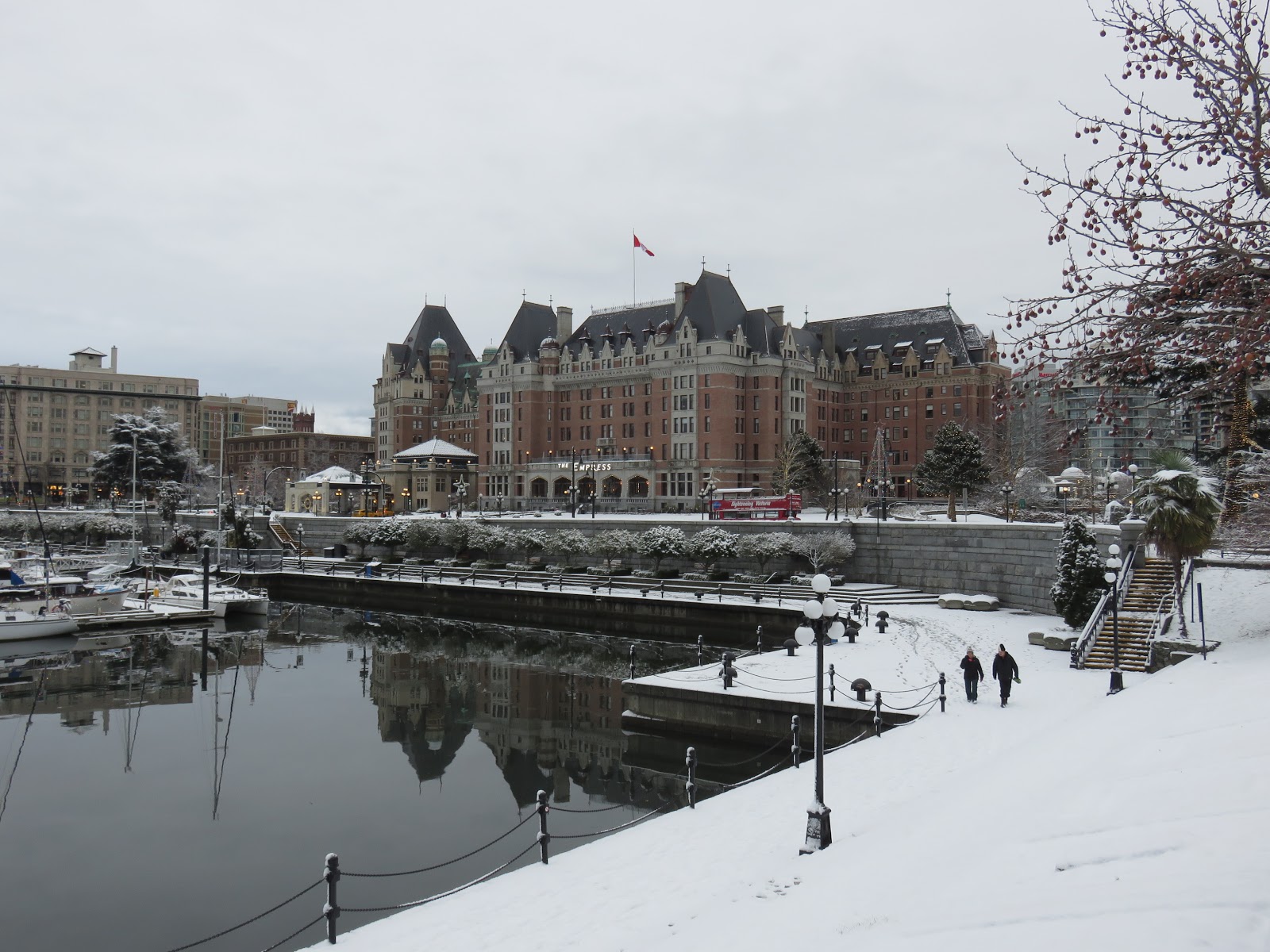
A snowy Victoria Inner Harbour on February 12, 2019

February 2019 was the coldest February in Victoria since 1936.  The mean monthly temperature was just 2.2 C, more than 4 degrees colder than the 30-year average mean monthly February temperature of 6.3 C.  It's very unusual to have such a large anomaly for the mean monthly temperature in Victoria.  The average daily maximum temperature was 4.7 C, which is 4.1 degrees cooler than the normal February maximum of 8.8 C.  The average daily minimum temperature was -0.4 C, which was 4.2 degrees cooler than the normal February minimum of 3.8 C.  This is the first month since November 1985 that Victoria Gonzales has recorded an average minimum temperature below 0. 

Perhaps even more impressive, this past month was the coldest of any month at Victoria Gonzales since November 1985 (34 years).  In the past 50 years, there have only been two other months which have been colder than this February: November 1985 (1.8 C) and January 1972 (2.1 C).  

The coldest temperature this month was -5.6 C on February 4.  The warmest temperature was 9.0 C on February 1.  There were 13 days this month when the overnight low was below 0 C.  This is the most "frost days" in February at Victoria Gonzales since 1936, when there was 17 days.  What is most notable about the cold weather this month is how the temperatures have stayed consistently below normal since February 3.  With 26 consecutive days below normal in February, and the cool weather forecast to continue into March, this will likely be one of the longest stretches of below-normal temperatures recorded at Victoria Gonzales in the  past 50 years.

As the chart below shows, temperatures around the region were very cold in February, with many locations experiencing their coldest February in decades.  The mean monthly temperature was 2.2 C at Victoria Gonzales and 1.8 C at the University of Victoria. As is typical, the temperature was quite a bit colder at the Victoria Airport (1.1 C), which had its coldest February since 1989.  Vancouver Airport (0.4 C) had its coldest February on record (going back to 1937).  Seattle Airport (2.5 C) had its third coldest February on record, and its coldest since 1989.


Mean Monthly Temperature, February 2019

We can take some solace in the fact that these unusually cold temperatures have been experienced throughout much of western North America.  Calgary has also had its coldest February since 1936 (the same year Victoria experienced its coldest February).  Even Los Angeles has had its coldest February since 1962 (57 years).  

The chart below compares daily maximum and minimum temperatures with the 30-year average daily maximums and minimums.  Temperatures plummeted on February 3rd, and remained extremely cold for the remainder of the first half of the month, with high temperatures most days not even reaching the average low temperature.  The second half of the month was slightly less cold, though still below normal.  


Daily Maximum and Minimum Temperatures at Victoria Gonzales, February 2019


In terms of precipitation, February 2019 was somewhat drier than normal, with 46.2 mm of precipitation versus the 30-year average of 61.4 mm.  The unusual thing about this month was how much of this precipitation fell as snow.  A total of 26 cm of snow fell in Victoria during the month, making it the snowiest month since December 2008.  Normal February snowfall in Victoria is 3.6 cm.  There was measurable snow on the ground for 7 days during the month, including 5 days with more than 2.5 cm on the ground.  Victoria actually got off lightly, since many locations around the region received significantly  more snowfall, including 68 cm at the Victoria Airport in North Saanich.

The chart below shows daily and cumulative precipitation at Victoria Gonzales.  The precipitation from February 3rd to 14th all fell as snow.  The wettest day was February 11th, with 14.8 mm of precipitation, which translated into about 16 cm of snow.   The second half of the month was quite dry.

Daily and Cumulative Precipitation at Victoria Gonzales, February 2019